
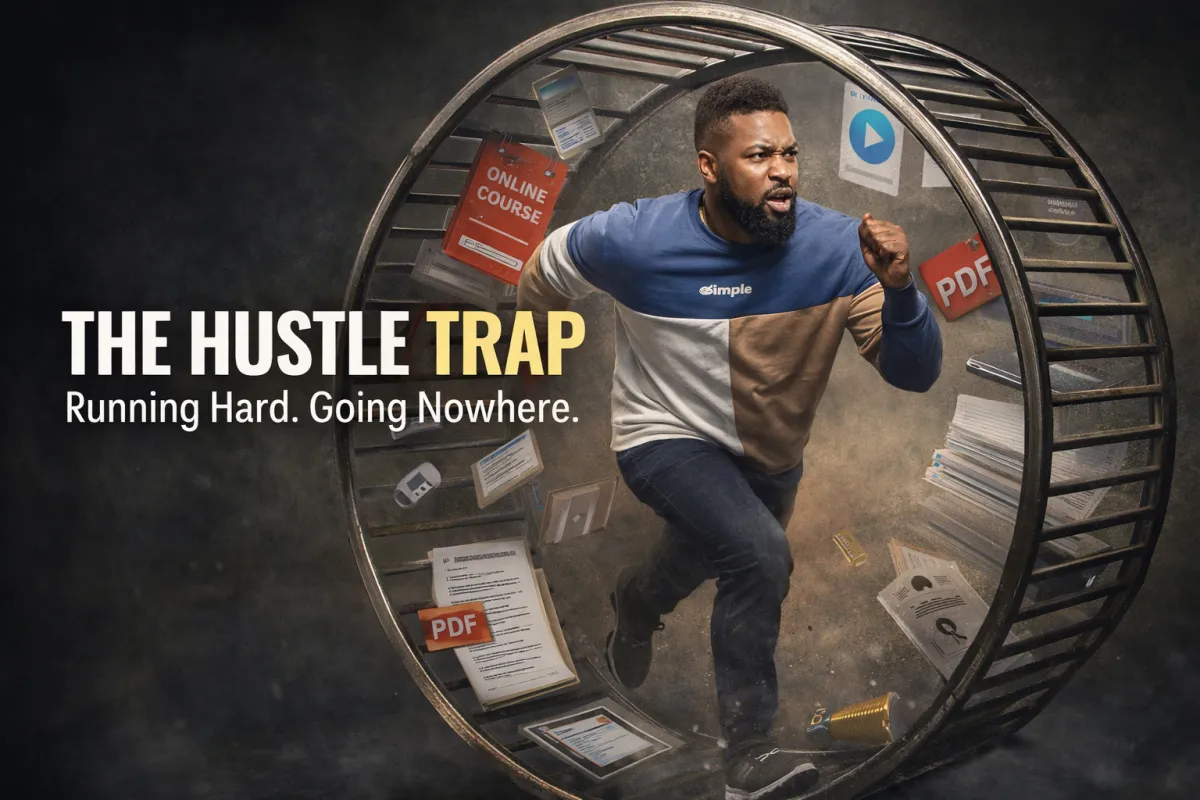
Why Hustle Culture Keeps You Broke
I didn't fail in business because I wasn't smart.
I failed because intelligence without infrastructure is useless.
I spent $3,000 to $4,000 on courses and tools that promised to fix my business. I had a hard drive full of PDFs. A browser full of bookmarks. A YouTube history that stretched back years.
I was smart enough to reverse engineer what I saw. That was never the problem.
The problem was that being smart enough and having the infrastructure to actually build something sustainable are two completely different things.
The Shallow Work Trap
Early in my business, I did everything.
I built websites. Designed graphics. Dabbled in ads. Wrote blogs. Managed databases. Played with SEO. Set up email sequences. Configured text marketing systems.
I felt productive. Busy. Like I was making progress.
But here's what I was actually doing: dispersing effort across disconnected tactics that never cohered into revenue-generating infrastructure.
I was building funnels that didn't convert. Running ads to broken systems. Creating content that led nowhere.
The work was real. The skills were legitimate. But without unified infrastructure, all that capability just scattered into motion without momentum.
Later, when I had a team, understanding all those different roles helped me manage better. But if I could go back, I'd tell myself to go deep on the things that actually matter: lead generation and sales conversion.
Everything else is noise until you solve those two problems.
The Kenyan Context: Hustle Without Systems
In Kenya, hustle culture is celebrated because survival demands it.
Side hustles, online gigs, crypto, forex, content creation—everyone is trying something.
The problem isn't effort.
It's that most people are stacking tactics without a system that compounds.
You're jumping from one opportunity to another, each time thinking this will be the one that works. But without infrastructure that ties your efforts together, you're not building momentum—you're just staying busy.
The same pattern plays out globally, but here it's amplified by the pressure to succeed fast, to prove the hustle is working, to show results now.
That pressure keeps you in the cycle. Buying the next course. Trying the next tactic. Never stopping long enough to build the foundation that would actually compound your efforts.
The $7,000 Wake-Up Call
I had a client paying me $7,000 to $8,000 per month. At the time, that felt significant.
Then regulatory issues forced them to close. The contract terminated.
I hadn't built a lead acquisition system. No pipeline. No systematic way to replace that revenue.
It took me six months to rebuild. I fell behind on bills. Lost money I'll never get back.
But more than that, I lost opportunities I don't even know existed. The ripple effects of having to scramble instead of build. The clients I could have serviced. The results I could have delivered.
That's when I realized: being capable at everything is different from having infrastructure that actually generates revenue.
I needed to make $10,000 from 100 clients, not from one. If I lost 10 clients, I'd still have the lion's share. The math just worked better.
That realization eventually led me to build Ignite Funnels. Something automated. Less hands-on. Less intensive on a daily basis. But still providing enormous value.
The Front-End Offer Economy
Here's how the cycle works:
You spend $100 or $200 on a course. It gives you a taste. A quick win. Some tactical knowledge.
But it's deliberately narrow. Designed to solve one specific problem while creating new gaps that require new purchases.
I didn't understand this at the time. I just saw the price tag and thought I was being smart by going cheap.
What I was actually doing was staying in permanent consumer mode instead of builder mode.
Front-end offers are designed to keep you buying. They solve a surface problem while withholding the comprehensive infrastructure that would eliminate your need to keep purchasing.
The field optimizes for this. Schools spend $125,000 for a license but decline the $25,000 training that comes with it. They think they can make it work on their own.
Entrepreneurs do the same thing. We buy the course but skip the infrastructure. We get the information but miss the implementation mechanism.
The average online course completion rate sits between 5-15% for free courses and 15-40% for paid ones. That's not a student problem. That's an infrastructure problem.
You're not failing because you lack discipline. You're failing because you bought a tactic when you needed a system.
The Education-to-Implementation Chasm
I finally invested $1,800 in a comprehensive program.
At the time, that was more than I'd ever spent on one thing. It was extremely uncomfortable.
But it became an inflection point that changed my life.
Here's what made it different:
It showed me how everything fit together. Not just from a tactical standpoint, but from an educational and philosophical one.
I finally understood why knowing your target demographic matters. How messaging plays into the framework. How to translate that messaging into offers. How to turn all of that into a system that captures attention, converts leads, and generates sales.
But the real difference was this: it gave me the mechanism to take information and turn it into something deployable.
Most programs load you up with knowledge but don't give you the means to implement. They sell you the blueprint but not the construction crew. The recipe but not the kitchen.
You end up with a hard drive full of PDFs and a bank account full of charges, but zero systematic pathway from capability to sustained income.
That's the chasm. And it's deliberate.
The Hamster Wheel Economics
The industry makes more money keeping you in the purchasing cycle than solving your problem comprehensively.
This isn't conspiracy. It's economics.
Business is expensive. Growth requires sizable profit margins. As you scale, costs compound. Server expenses. Storage. Ad costs that grow at ridiculous rates every year.
So businesses face a choice: build comprehensive infrastructure that solves the problem once, or create a product ecosystem that requires ongoing purchases.
Most choose the latter because the math works better for them.
They sell you the funnel builder but not the traffic system. The email platform but not the conversion strategy. The automation tool but not the operational framework.
Each solution creates new gaps. Each gap requires new purchases.
You're not building. You're just busy.
And here's the thing: burned-out workers have a 60% reduced ability to focus and are 32% less productive than those with healthy working habits.
The hustle without systems doesn't just fail to produce results. It actively destroys your capability to produce them.
What Comprehensive Infrastructure Actually Looks Like
When I built Ignite Funnels, I made a specific choice.
Instead of forcing you to string together dozens of different SaaS systems, we integrated everything natively. We removed the per-module pricing and built it into one price.
The connective tissue is education. We create content that helps you understand the system, how to deploy it, and why it's needed.
Everything integrates automatically. One less thing to worry about. One less thing that could break. One less thing to learn.
This goes against how most of the industry operates. I could make more money selling each piece separately. Keeping you dependent on buying the next integration. The next upgrade. The next module.
But the goal is to help people win and get to the finish line.
I know you need all these components eventually. You may not need them right now, but you will. And if I constantly gate and keep you in a cycle of buying, some of you will hit the point where you really need it but simply can't afford it.
I can't promise the pricing model will never change. As we grow, we have to balance accessibility, affordability, and survivability of the enterprise.
That's the tightrope. The honest reality that most entrepreneurs don't want to talk about.
But right now, the focus is making sure people get access to technology that actually works, information that actually helps, and infrastructure they can actually use to scale and grow.
How to Break the Cycle
If you're stuck in the hamster wheel right now, here's how you recognize it:
You're not diving deeper into what you purchased. You're skimming the surface and moving to the next thing.
You're not seeing results after spending decent time. Your skills aren't sharpening. Your lead time to success isn't decreasing.
You're progressing in knowledge but not in revenue. You know more but earn the same.
At that point, you have to be honest with yourself about two things:
First, are you actually putting in the time and energy it takes to get results? If you're not, it doesn't matter how good the product or service is. Effort still matters.
Second, if you are putting in the time and not seeing results, you probably need to dive deeper. Or you need different infrastructure entirely.
Because here's the truth: you're either going to spend time to acquire the skills necessary to get results, or you're going to spend money to cut the time it takes.
There is no third avenue.
The ones who become great do both. They spend the time and they spend the money.
But they spend it on comprehensive infrastructure, not fragmented tactics. On systems that integrate, not tools that create new gaps. On programs that provide implementation mechanisms, not just information dumps.
The Real Cost of Shallow Work
I wasted time. Lost opportunities. Delayed getting to where I am now by years.
The cost wasn't just the $3,000 to $4,000 I spent on courses. It was the opportunity cost. The money I could have made. The clients I could have serviced. The results I could have delivered.
Opportunities have ripple effects. When you're caught in shallow work, you lose opportunities you don't even know existed.
I had months where I made good money. Then months where I made nothing. The inconsistency came from not having systematic infrastructure.
It wasn't until I realized that picking one horse and sticking to it would take me further than jumping from one to another.
That's the pattern. That's what keeps you broke.
Not lack of effort. Not lack of intelligence. Not lack of capability.
Lack of infrastructure.
The field sells you hustle because it's easier to market than systems. Motivation converts better than mechanism. Speed and ease drive more transactions than truth and realistic timelines.
But hustle without infrastructure just keeps you running on a wheel that goes nowhere.
You're not building wealth. You're building someone else's revenue stream while exhausting yourself in the process.
The way out is simple but uncomfortable: stop buying motion and start building infrastructure.
Commit to one comprehensive system. Go deep instead of wide. Pay for the implementation mechanism, not just the information.
And recognize that sustainable transformation takes time. Multi-year time. Not the compressed fiction sold in marketing copy.
That's the reality. That's what works.
Everything else is just keeping you busy while keeping you broke.
What Real Infrastructure Looks Like
If you want to understand what real infrastructure actually means—how leads, messaging, automation, and sales connect into one system instead of scattered tactics—that's the problem Ignite Funnels was built to solve.
Not with hype. Not with promises of overnight success.
With comprehensive infrastructure that eliminates the hamster wheel by giving you something actually worth sustaining effort toward.
Because at the end of the day, hustle doesn't keep you broke.
Hustle without infrastructure keeps you broke.