
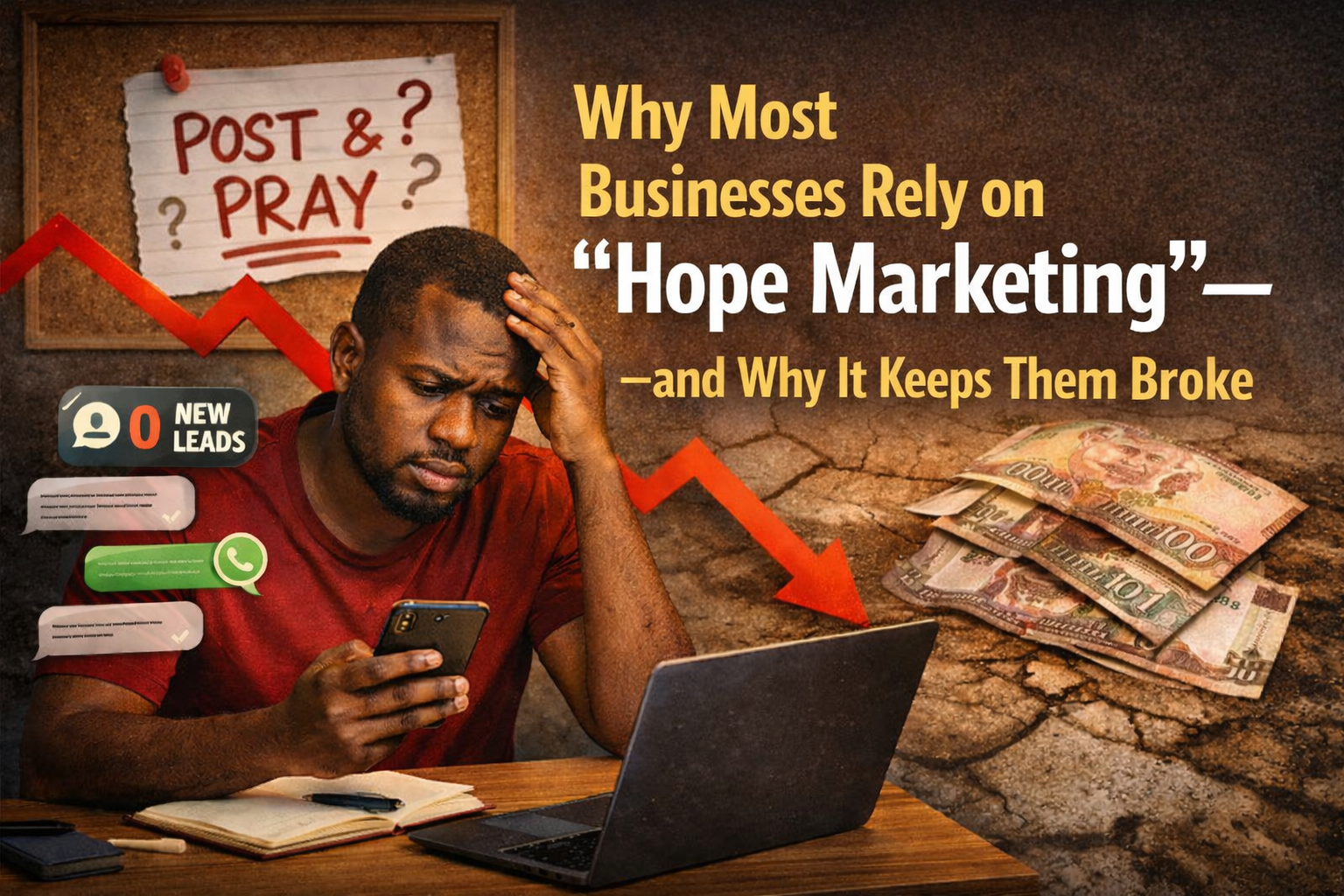
Why Most Businesses Rely on ‘Hope Marketing, and Why It Keeps Them Broke!
I spent twelve months tracking Kenyan businesses on Instagram and Facebook. Same niche. Similar follower counts. Posting daily.
Most got likes, comments, the occasional "DM for price" inquiry that went nowhere.
Three businesses generated predictable revenue every single week.
The difference wasn't their content quality. It wasn't their posting frequency. It wasn't even their follower count.
The difference was infrastructure.
The Hope Marketing Trap
Here's what I watched happen on repeat:
A business posts beautiful product photos. Gets 47 likes. Maybe 8 comments. Post again the next day. And the next. And the next.
End of the month arrives. Revenue is unpredictable. Some months, 15 sales. Other months, 3.
Same effort. Wildly different results.
This is what I call hope marketing. You post content and hope someone sends a direct message. Hope they're serious. Hope they actually buy.
Kenya has over 24 million active social media users as of 2025. The reach is massive. The opportunity feels real.
But here's what the data actually shows: social media converts between 1% and 2.1% of leads into customers. That means 98-99% of your social media audience will never buy from you.
Not because your product is bad. Not because your content is weak.
Because social media wasn't built to capture and convert leads systematically.
What the Three Businesses Built Instead
The three businesses that generated consistent revenue did something different.
They stopped treating social media as their sales floor.
They started treating it as their traffic source.
Here's the infrastructure they built:
1. A lead capture page
Not a complicated website. A single page with a clear offer and an email collection form.
"Get our product catalog + 10% off your first order."
"Download our free sizing guide."
"Join our weekly deals list."
Simple. Focused. One action.
2. An automated email sequence
Once someone entered their email, they received a series of automated messages over 7-14 days.
Not daily spam. Strategic follow-up.
Email 1: Deliver what you promised (catalog, guide, discount code).
Email 3: Share customer results or testimonials.
Email 5: Address common objections.
Email 7: Make a clear offer with urgency.
The system ran without manual intervention. No hoping someone remembers to DM you three days after seeing your post.
3. A measurement dashboard
They tracked everything. How many people clicked their link. How many gave their email. How many opened the emails. How many bought.
This gave them what hope marketing never could: predictability.
The Numbers That Changed My Perspective
I didn't believe this infrastructure approach would work in Kenya until I saw the conversion data.
Automated email campaigns generate $36-$45 for every $1 spent in e-commerce and retail. That's a 3,600%-4,500% return on investment.
More striking: automated emails drive conversion rates 2,361% better than regular bulk campaigns. One in three people who click on automated emails makes a purchase. Compare that to one in eighteen for bulk campaigns.
Email marketing converts at 6-10%. Social media converts at 1-2%.
The gap isn't small. It's structural.
But here's what matters more than the percentages: consistency.
The businesses using lead capture infrastructure knew exactly how many leads they needed to hit their revenue targets. They knew their conversion rates. They knew how much traffic they needed to drive.
The businesses using hope marketing had no idea if next month would bring 5 sales or 25.
Why Most Kenyan Businesses Don't Build This Infrastructure
I talked to 47 business owners about why they weren't using lead capture pages and email automation.
The answers fell into three categories:
"It sounds complicated."
It's not. You need a landing page tool (many free options exist), an email service provider (free up to 500-1,000 subscribers), and 3-4 hours to set up your first sequence.
The complexity is a barrier, not a requirement.
"I don't have money for all that."
The businesses I tracked spent between 0-2,500 KES monthly on their infrastructure. Most started completely free and upgraded only after they were generating revenue.
Capital isn't the blocker. Knowledge of what infrastructure to build is.
"My customers prefer WhatsApp and Instagram DMs."
Your customers will use whatever system you build. The question is whether that system serves you or exhausts you.
Responding to DMs manually works when you have 10 inquiries a month. It collapses when you scale to 100.
Infrastructure scales. Manual effort doesn't.
The Pattern I Keep Seeing
Here's what happens when capable people operate without infrastructure:
Month 1-3: Excitement. Posting daily. Getting engagement. Making some sales.
Month 4-6: Frustration. Same effort, declining results. Revenue becomes unpredictable.
Month 7-9: Exhaustion. Burnout from constant content creation with inconsistent return.
Month 10-12: Abandonment. "Social media doesn't work for my business."
The capability was there. The effort was there.
The infrastructure wasn't.
I've watched this pattern destroy businesses that had real potential. Not because they lacked talent. Not because their products were inferior.
Because they built their revenue model on hope instead of systems.
What Changed for the Three Businesses
Six months after implementing lead capture infrastructure, here's what the three businesses reported:
Business A (Handmade Jewelry):
Before: 8-15 sales per month, all from direct Instagram DMs. Revenue: 45,000-85,000 KES monthly.
After: 22-28 sales per month, 70% from email automation. Revenue: 110,000-140,000 KES monthly.
Business B (Skincare Products):
Before: 12-20 sales per month, unpredictable timing. Revenue: 60,000-100,000 KES monthly.
After: 35-42 sales per month, predictable weekly revenue. Revenue: 175,000-210,000 KES monthly.
Business C (Digital Products):
Before: 5-10 sales per month, heavy time investment per sale. Revenue: 25,000-50,000 KES monthly.
After: 18-25 sales per month, minimal time per sale. Revenue: 90,000-125,000 KES monthly.
The revenue increase matters. But what mattered more to these business owners was the predictability.
They could plan. They could forecast. They could make business decisions based on data instead of hope.
The Infrastructure Gap Nobody Talks About
Kenya's digital economy is expected to reach $180 billion by 2025. Internet penetration sits at 85.2%.
The opportunity is real.
But many SMEs lack the advanced skills needed to leverage digital marketing tools beyond basic social media use.
This isn't a capability problem. This is an infrastructure access problem.
The field sells you courses on "content creation" and "social media strategy." It tells you to post more, engage more, be more consistent.
It doesn't tell you that content without conversion infrastructure is just noise.
I spent a decade navigating this gap myself. Learning email marketing. Understanding automation. Building landing pages. Testing conversion optimization.
It took me years to figure out what should have taken weeks.
The information exists. The tools exist. What's missing is the clear operational pathway from "I have a product" to "I have predictable revenue."
What This Means for You
If you're posting daily and hoping for DMs, you're not failing.
You're operating without the infrastructure that makes consistent revenue possible.
The businesses that win aren't more talented. They aren't luckier. They aren't working harder.
They built systems that convert attention into revenue without requiring manual intervention for every single transaction.
You can keep hoping your next post goes viral.
Or you can build infrastructure that makes virality irrelevant.
The choice is yours. But understand what you're choosing between.
Hope marketing feels easier in the short term. It requires no new learning. No setup time. No technical navigation.
It also produces inconsistent results, unpredictable revenue, and eventual burnout.
Infrastructure requires upfront effort. Learning. Setup. Testing.
It also produces predictable leads, measurable conversions, and sustainable growth.
I know which one I'm building.
Where to Start
If you're ready to move from hope to infrastructure, here's the sequence:
Week 1: Create one lead capture page with one clear offer. Use a free landing page tool.
Week 2: Set up a free email service account. Write your first 5 automated emails.
Week 3: Connect your landing page to your email service. Test the entire flow yourself.
Week 4: Drive traffic from your social media to your lead capture page. Measure everything.
This isn't complicated. It's just different from what you're doing now.
The businesses that figured this out aren't special. They just stopped treating social media as their entire business model and started treating it as one component of a larger system.
You have the capability. You have the drive.
Now build the infrastructure that converts both into sustained revenue.
The alternative is posting daily and hoping this month is better than last month.
I've watched that approach for twelve months straight.
It doesn't get better without infrastructure.
Ready to Build Your Infrastructure?
If you're done with hope marketing and ready to build a system that generates predictable leads, you can start today.
Ignite Funnels gives you everything you need: landing pages, email automation, and analytics—all in one platform built for businesses like yours.
No technical expertise required. No massive upfront investment. Just the infrastructure that converts your social media traffic into measurable revenue.
Get started with a free 14-day trial. Build your first lead capture page, set up your automated email sequence, and see what predictable revenue feels like.
Stop hoping. Start building.